
Financial Time Series (ATA Certification Program)
About Course
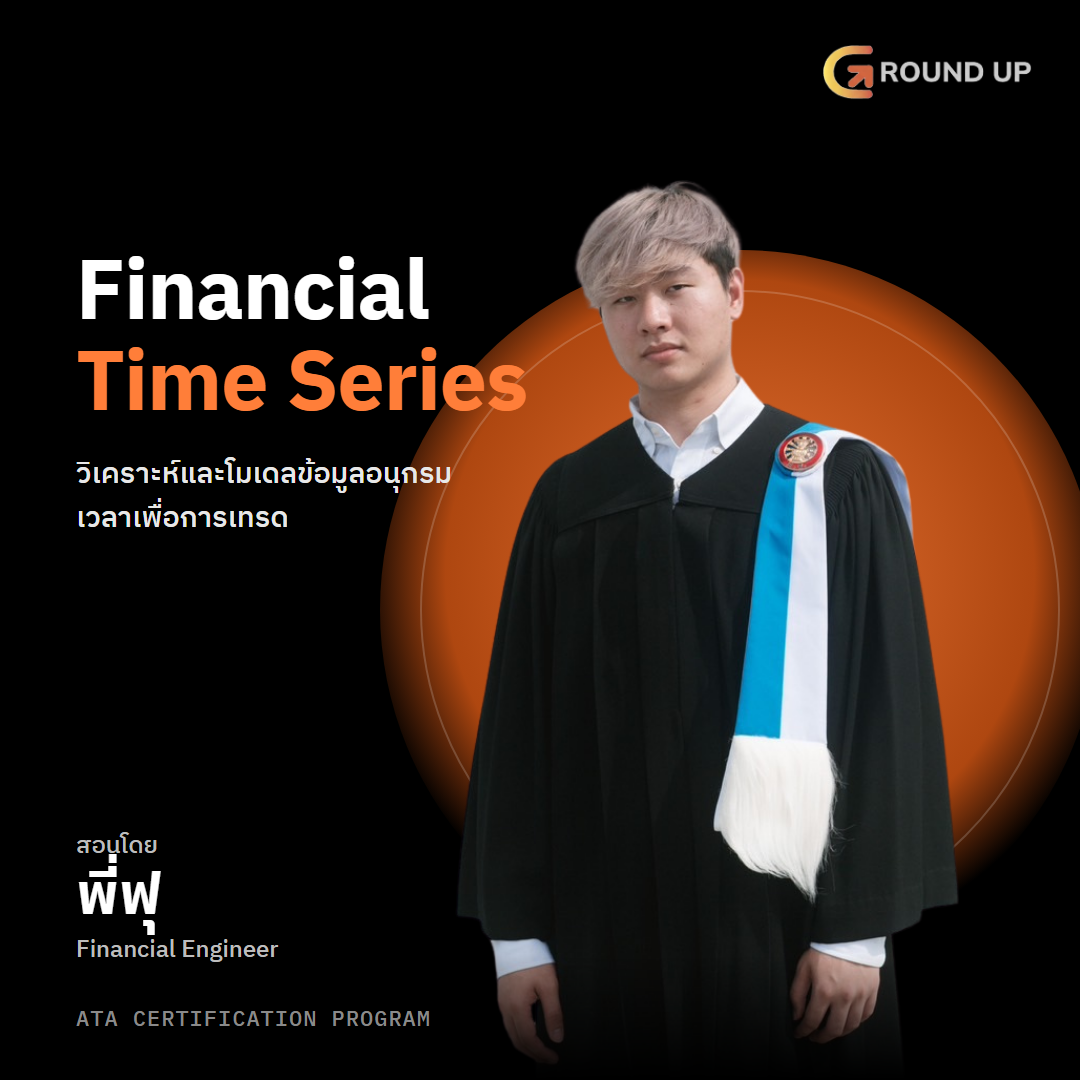
Financial Time Series
วิเคราะห์และโมเดลข้อมูลอนุกรมเวลาเพื่อการเทรด
วิชานี้อยู่ในหลักสูตร Algorithmic Trading in Action (ATA) Certification Program — Quant Series
ของ GroundUp Academy เรียนแบบ Video on Demand ดูย้อนหลังได้ตลอด
สอนโดย พี่ฟุ Financial Engineer
เริ่มจากการเตรียมและทดสอบข้อมูลราคา ต่อด้วยโมเดลอนุกรมเวลาและความผันผวน
จากนั้นเข้าสู่เครื่องมือที่ใช้กับ Statistical Arbitrage ได้แก่ cointegration, Kalman Filter และ Copula
เรียนผ่านโค้ด Python
Module 1: Financial Time Series Foundations
1.1 Ingesting & Aligning Financial Data
ดึงข้อมูลตลาดด้วย Python (yfinance, pandas) จัดการค่าที่หายไป ปฏิทินวันทำการ และจัดแนว timestamp ระดับไมโครวินาทีสำหรับการวิเคราะห์เหตุการณ์
1.2 Returns, Volatility & Stationarity Tests
simple return เทียบกับ log return การคำนวณ rolling volatility และทดสอบความนิ่ง (stationarity) ด้วย Augmented Dickey-Fuller (ADF) และ KPSS
1.3 Decomposition & Trend Analysis
แยกอนุกรมเวลาเป็น trend, seasonality และ residual ด้วย moving average และ Exponential Weighted Moving Average (EWMA)
Module 2: Classical Time Series & Volatility
2.1 Autocorrelation & Stationarity Signals
วิเคราะห์ Autocorrelation (ACF) และ Partial Autocorrelation (PACF) เพื่อหาโครงสร้างความจำแบบ mean-reverting ใน returns ของสินทรัพย์
2.2 ARIMA Modeling & Out-of-Sample Forecasts
ฟิต ARIMA ด้วย statsmodels เลือกอันดับ (p, d, q) ด้วยเกณฑ์ AIC/BIC และประเมินการพยากรณ์ทิศทางนอกตัวอย่าง (out-of-sample)
2.3 GARCH Volatility & Dynamic Rescaling
โมเดล volatility clustering ด้วย GARCH(1,1) จากแพ็กเกจ arch เพื่อคำนวณ conditional variance แบบไดนามิกสำหรับควบคุมความเสี่ยง และ standardized residuals
Module 3: Cointegration & StatArb Foundations
3.1 Spurious Regression & Cointegration
แยกความต่างระหว่าง correlation กับ cointegration ทดสอบ Engle-Granger สองขั้นตอน และสร้าง spread residual ที่นิ่งจากสินทรัพย์ที่ไม่นิ่ง
3.2 Half-Life & Spread Dynamics
คำนวณพารามิเตอร์ของกระบวนการ Ornstein-Uhlenbeck (OU) เพื่อวัดความเร็วการกลับสู่ค่าเฉลี่ยของ spread (half-life) และติดตามระดับ Z-score
Module 4: State-Space Models & Dynamic Estimates
4.1 State-Space Formulations
จัดอนุกรมเวลาให้อยู่ในรูป observation equation และ transition equation แยกตัวแปรสถานะที่มองไม่เห็นออกจาก noise ที่สังเกตได้
4.2 Dynamic Estimation via Kalman Filtering
เขียน Kalman Filter แบบ recursive ด้วย Python เพื่อประมาณ hedge ratio (β) ที่เปลี่ยนตามเวลา โดยไม่มี look-ahead bias และไม่ต้องพึ่ง rolling window
Module 5: Copula Models & Multivariate Dependency
5.1 Joint Distributions & Marginal Fitting
แยกการแจกแจงรายตัว (marginal) ด้วยวิธี parametric หรือ KDE ออกจากโครงสร้างความสัมพันธ์หลายตัวแปร
5.2 Copula Fitting & Non-Linear Dependency
ฟิต Gaussian, t-Student และ Archimedean (Clayton/Gumbel) Copula เพื่อจำลองการเคลื่อนไหวร่วมแบบไม่เป็นเส้นตรงและ tail dependence
ใบรับรอง
ผู้เรียนที่เรียนครบทุกวิชาในหลักสูตรและส่งโปรเจกต์ backtest ระบบเทรด 1 ระบบ
จะได้รับใบรับรองจาก GroundUp Academy
Course Content
Course Syllabus
-
0.Introduction to Time Series
08:29 -
1.1 Financial Time Series Foundations
23:58 -
1.2 UNIT ROOTS, ADF & KPSS
36:23 -
2.1 Classical Time Series & Volatility
30:06 -
2.2 AIC & BIC
26:23 -
2.3 ARCH & GARCH
30:26